AUTHOR
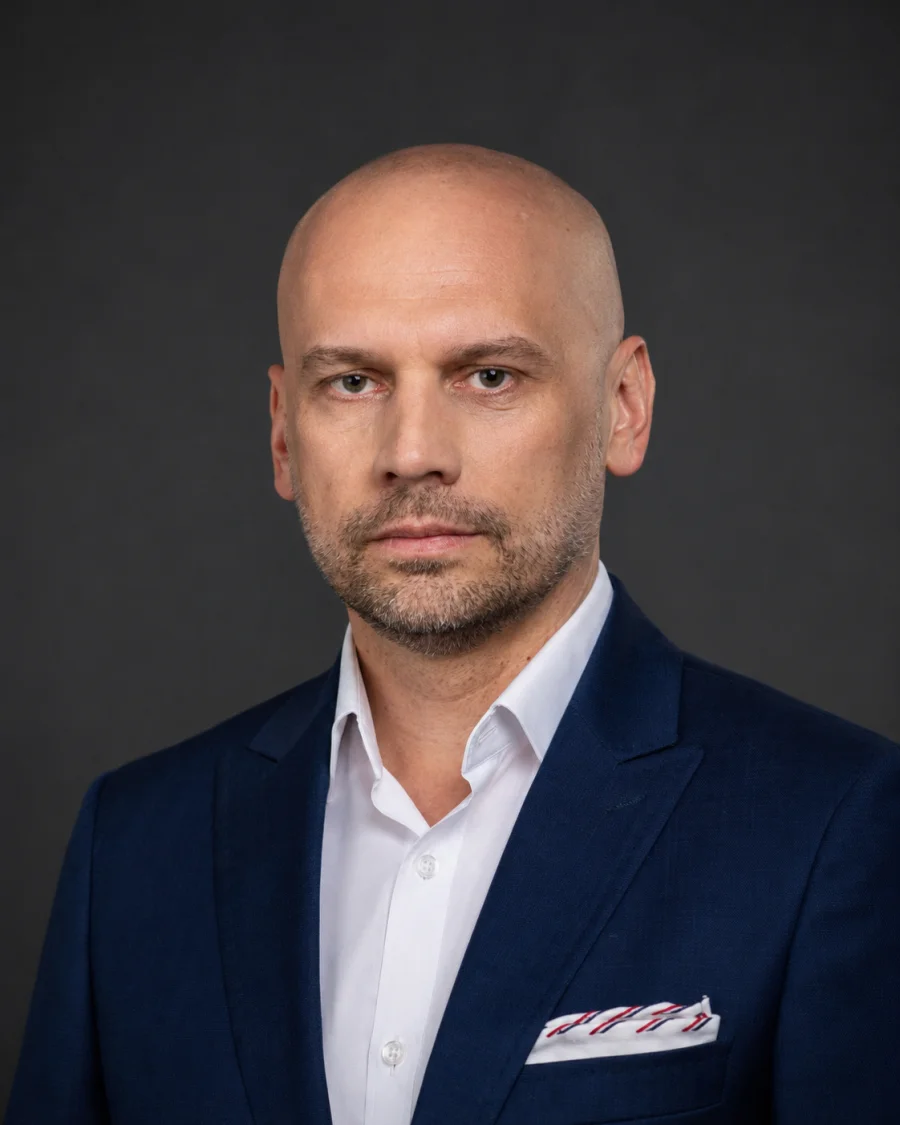
Michał Zwyrtek
Partner
Combines a financial, advisory and digital perspective in strategic and implementation projects.
Full profile
Michał Zwyrtek explains how AI, digital transformation and organisational readiness can support succession in a family-owned business.
On 29 October 2026, Michał Zwyrtek, partner and co-founder of Zwyrtek Group, spoke and served as a panellist at the “Sukcesja w biznesie” (Succession in business) conference at Akademia Górnośląska im. Wojciecha Korfantego in Katowice. The event was organised by the Polish Economic Society – Katowice Branch and Akademia Górnośląska im. Wojciecha Korfantego.
His presentation, “Firma gotowa na sukcesję: jak AI i transformacja cyfrowa zmieniają wartość biznesu rodzinnego” (A business ready for succession: how AI and digital transformation change the value of a family business), addressed preparing a business not only for the formal transfer of ownership, but also for continued, independent development under the next generation. Michał Zwyrtek also served as a panellist in “Dwa pokolenia, dwie wizje – jak połączyć doświadczenie z innowacją?” (Two generations, two visions – how can experience and innovation be combined?).
The event also marked the launch of the monograph “Bariery i wyzwania w procesie sukcesji. Wybrane problemy zmiany pokoleniowej” (Barriers and challenges in the succession process. Selected issues in generational change), academically edited by Barbara Rychta and Barbara Cyganik. Michał Zwyrtek is a co-author: he wrote the chapter “Sukcesja w polskich przedsiębiorstwach prywatnych i rodzinnych. Wybrane zagadnienia” (Succession in Polish private and family businesses. Selected issues). These three perspectives — the presentation, the generational discussion and the publication — share a question: what does a business ready for succession really look like?
Succession of a family business is not simply a transfer of shares, the preparation of a will or the establishment of a family foundation. Legal arrangements organise ownership and may support continuity, but do not themselves ensure that a business can continue to develop. The next generation should receive an organisation with accessible knowledge, reliable data and clearly defined responsibilities.
Effective succession involves interconnected areas:
A business can be formally transferred to successors while remaining operationally dependent on its founder. If every significant decision, quotation or conversation with a key client requires the founder’s involvement, ownership has changed but the way the business operates has not. This does not mean succession is complete.
It is worth distinguishing the roles of owner, family member and manager. Not every successor needs to manage day-to-day operations, and professional management does not preclude family control. Agreeing these roles reduces misunderstandings and helps establish a model suited to the particular family and business.
A succession-readiness test starts with the way the business functions each day. Management, owners and successors should jointly answer the following questions:
Answers should be supported by evidence: process maps, decision-making authority, management reports, deputising arrangements and documentation of key relationships. The purpose is not documentation for its own sake. It is to establish whether the team can use knowledge and make decisions without referring back to the founder on every occasion.
Dependence on one person is not only a succession risk. It can constrain business value, scalability and the ability to attract an investor. A business whose performance relies on the founder’s constant presence is harder to develop and assess as a buyer. Reducing this dependence is not about sidelining the founder; it is about deliberately transferring knowledge, authority and responsibility.
Digital transformation can support succession by changing how people work, rather than merely purchasing new systems. Technology helps preserve knowledge and enables data-led management when it is tied to a specific business objective.
Support may include:
For example, an orderly client-information system can move relationship histories from private notes into the organisation. A knowledge base can make procedures and experience accessible to the team, while management reporting can show margins, liquidity and variances without the owner manually gathering data. AI can help retrieve information, prepare analyses and identify exceptions, but its output requires assessment by the person accountable for the decision.
AI will not repair a poorly designed process. Automating chaos may simply accelerate it. If data is inconsistent, responsibilities unclear and operating rules exist only in the owner’s memory, introducing a tool does not remove the underlying problem.
The starting point should be the business objective, a process map, data quality and a person accountable for the outcome. A solution can then be selected, a limited pilot conducted and its impact on working time, quality, errors and team independence assessed. The number of licences or automations deployed is not, by itself, a measure of succession readiness.
AI implementation requires information-access rules, protection of personal and confidential data, supplier assessment and human oversight. The business must define what data may be provided to a tool, who checks its output and who is responsible for the decision. Legal requirements need to be assessed for the particular use case.
Communication, user training and preparation of managers are equally important. Technology does not replace ownership decisions or conversations between generations. It can, however, improve independence, scalability, resilience and business value when it supports orderly processes and deliberate change management — without guaranteeing a particular outcome.
Following the expert presentations, Michał Zwyrtek served as a panellist in “Dwa pokolenia, dwie wizje – jak połączyć doświadczenie z innowacją?” (Two generations, two visions – how can experience and innovation be combined?). The panel addressed relationships between founders, successors and those supporting business transformation.
Good succession is not a choice between the older generation’s experience and successors’ ideas. Its purpose is to create a model that can:
The founder can contribute knowledge of the market, relationships and the history of key decisions; the successor can bring new skills, a technological perspective and development ideas. Agreed boundaries of responsibility are needed for these resources to complement each other. Assigning a task without decision-making authority is not a transfer of management; innovation without understanding the business model does not ensure continuity either.
The conference also marked the launch of “Bariery i wyzwania w procesie sukcesji. Wybrane problemy zmiany pokoleniowej” (Barriers and challenges in the succession process. Selected issues in generational change), academically edited by Barbara Rychta and Barbara Cyganik.
Michał Zwyrtek is a co-author of the publication. He wrote the chapter “Sukcesja w polskich przedsiębiorstwach prywatnych i rodzinnych. Wybrane zagadnienia” (Succession in Polish private and family businesses. Selected issues).
The publication combines an academic perspective with the challenges faced by family businesses, including legal, financial, psychological, organisational and managerial issues. It highlights the importance of looking beyond the mechanism for transferring ownership: generational change also concerns people, working practices and family relationships. The English translations of titles above are provided for reference; they do not indicate an English-language edition of the monograph.
Support for private and family businesses should combine the ownership plan with preparation of the organisation to implement it. The choice of solutions depends on the family’s circumstances, the business structure and the next generation’s intentions. A family foundation is one possible tool, not a universal answer to every situation.
Zwyrtek Group can support:
Business advisory helps bring these areas together in a coherent plan: establishing priorities, a timetable, responsibilities and a way to assess progress. The plan should address both formal decisions and the organisation’s day-to-day operation after implementation. A free consultation on the business’s succession readiness can be a starting point.
A well-planned succession does not bring the founder’s business story to an end. It creates the conditions for the next generation to develop it with purpose.
Combines a financial, advisory and digital perspective in strategic and implementation projects.
Full profileMichał Zwyrtek shares lessons from the CFO Forum 2026 and QUANTUM meeting on AI, leadership and organisational change.
Michał Zwyrtek attended both days of GITEX AI Europe 2026 in Berlin, following discussions on AI, infrastructure, cybersecurity, digital sovereignty, deep tech and business transformation.
Michał Zwyrtek delivered a talk at the “Digital HoReCa: Automation and Security” conference on using AI, automation, revenue management and data in hospitality and food service.
We can assess the ownership, organisational, legal and technological readiness of the business and help plan the transfer of responsibility to the next generation.