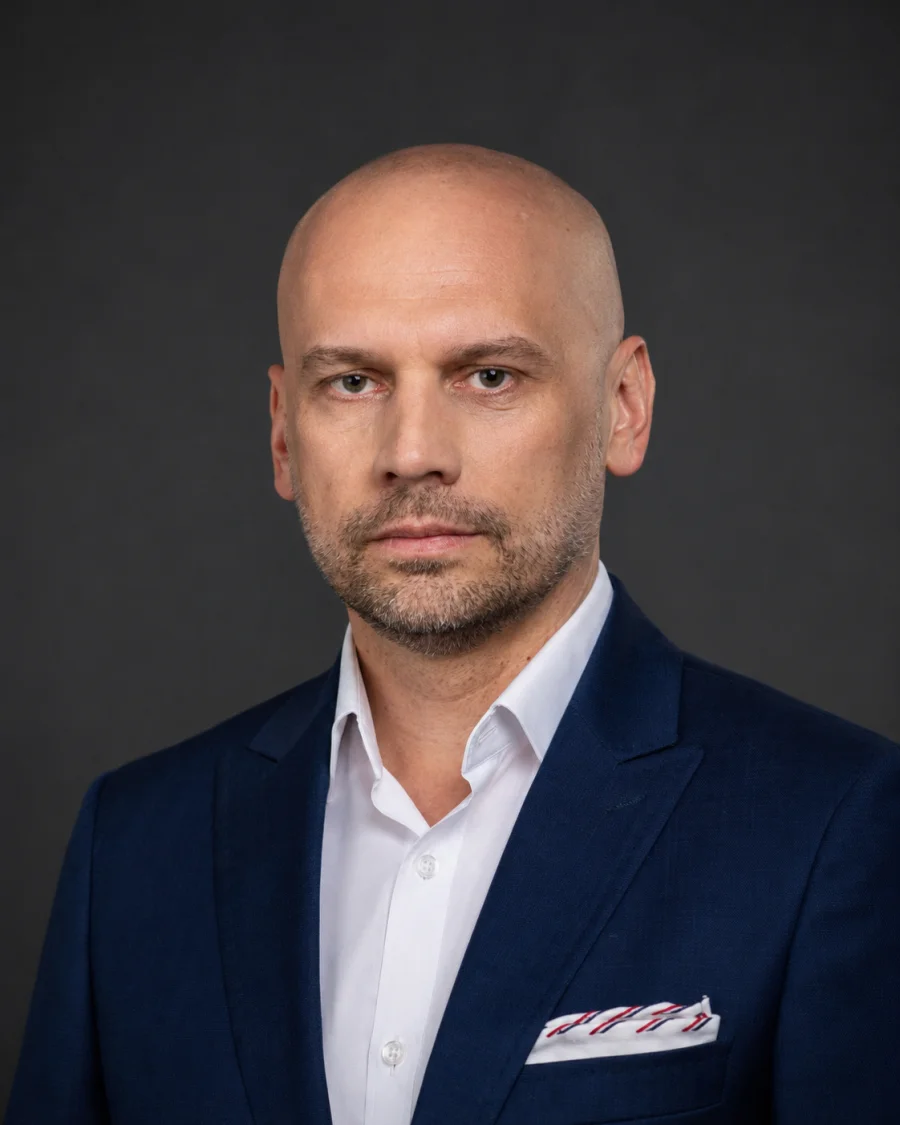
AUTHOR
Michał Zwyrtek
Partner
Combines a financial, advisory and digital perspective in strategic and implementation projects.
Full profile
Michał Zwyrtek shares lessons from the CFO Forum 2026 and QUANTUM meeting on AI, leadership and organisational change.
In October 2026 I had the pleasure of representing Zwyrtek Group at two very different events: the CFO Forum 2026 (Forum Dyrektor Finansowy) in Warsaw on 14–15 October, organised by ADN Akademia, and a meeting with the QUANTUM Financial Modelling Student Research Club at the University of Economics in Katowice on 19 October. At both I spoke about the same themes: artificial intelligence, leadership and change management. The shared conclusion from both conversations is simple — competitive advantage does not come from owning technology. It comes from an organisation’s ability to use technology within a better process, with clearly defined accountability and a measurable business objective.
The first meeting was a discussion with experienced chief financial officers and business leaders who are accountable for results and transformation budgets every day. The second was a lecture for students who will be leading those transformations themselves in a few years’ time.
Different perspectives, different experience, different expectations. Yet both conversations revolved around the same question: why do growing investments in AI and automation so often fail to deliver the expected business results?
The CFO Forum 2026 took place on 14–15 October in Warsaw under the motto “Leadership of the future: strategy, technology and people at the centre”, organised by ADN Akademia.
I had the opportunity to deliver the opening keynote and then to moderate a thematic roundtable: “Technological leadership — the art of taking the helm in a world of AI and new technologies”. At the table, together with experienced CFOs and business leaders, we discussed precisely why AI investments so rarely translate into measurable outcomes.
Several recurring conclusions emerged from the discussion:
The workshop and discussion part, and the exchange of experience between participants, proved particularly valuable. It is in those conversations — beyond the formal agenda — that you see most clearly what organisations genuinely struggle with.
The Forum also featured an interesting conversation on diplomacy, trust and building value with Marek Brzezinski and Olga Leonowicz — a welcome reminder that leadership is about far more than technology.
On 19 October, at the invitation of the QUANTUM Financial Modelling Student Research Club, I returned to the University of Economics in Katowice — my alma mater. This time not as a student, but as a practitioner sharing business experience. That is always a special feeling.
The lecture was titled “AI does not change organisations. People do. Change management in the age of artificial intelligence”. We discussed why technology alone does not change an organisation and why AI reshapes people’s roles, tasks and responsibilities. We devoted considerable time to communication, preparing managers and users, trust in new tools, governance rules, critically assessing AI-generated output and the importance of business and process knowledge.
One thread deserves particular emphasis. Resistance to change is not always a problem to be overcome. It is often a signal that:
Before we label someone as “resistant”, it is worth checking whether the organisation has done its part of the work.
I told the students plainly: their edge in the labour market will not come from knowing AI tools alone. Just as important will be:
My thanks go to the QUANTUM Financial Modelling Student Research Club and the University of Economics in Katowice for the invitation, and to all participants for their attendance and questions. Special thanks to Amelia Bochenek — for the invitation, the organisation, the turnout and the energy of the event.
Experienced CFOs in Warsaw and students in Katowice look at AI from entirely different places. One group is accountable for results and risk; the other is only just building its competencies. And yet the conclusions from both conversations are strikingly similar.
Advantage is not created by merely possessing technology. It is created by an organisation’s ability to use technology within a better process, with clearly defined accountability and a measurable business objective.
From both events I take away three principles that I also repeat to our clients.
An AI project should begin with a problem and a measurable goal, not with a tool demonstration. The goal might be shortening process time, reducing cost, improving quality, lowering risk, improving margin, better decisions or a better customer experience. If we cannot name the goal, we are not ready to choose the technology.
Transformation needs a sponsor on the board, a business owner and engaged middle managers. It needs communication, training, user support and a clear allocation of responsibilities. A tool can be purchased in a month. Changing how people work requires consistent leadership.
We measure success by outcomes: process completion time, error rates, data quality, process cost, productivity, decision quality, adoption levels, impact on financial results and risk reduction. The number of licences, models, chatbots or pilots is not, in itself, proof of success.
This sentence came up in both conversations and is worth repeating. Technology is available to everyone today — the difference lies not in access to models, but in how an organisation reshapes the processes, roles and decisions around them. Effective transformation brings together strategy, finance, processes, data and people, with IT as one participant in the process rather than its sole owner.
We wrote more about leading an organisation through change in our article on change management in digital transformation and AI.
At Zwyrtek Group we help organisations move from a tool to an outcome. We support them in implementing AI in business, business advisory and broader digital transformation programmes, always starting with a diagnosis of the problem and the process rather than a technology choice. For teams that want to build practical skills, we also run the Zwyrtek Academy training catalogue.
AI does not change organisations. People do — provided they know why, know how and are supported along the way. Technology is merely a tool. Value is created when a clear business objective meets a sound process and people who understand their role in the change.
Combines a financial, advisory and digital perspective in strategic and implementation projects.
Full profileMichał Zwyrtek delivered a talk at the “Digital HoReCa: Automation and Security” conference on using AI, automation, revenue management and data in hospitality and food service.
Michał Zwyrtek attended both days of GITEX AI Europe 2026 in Berlin, following discussions on AI, infrastructure, cybersecurity, digital sovereignty, deep tech and business transformation.
Zwyrtek Group was a partner of the Marketing & Digital Experts Summit 2026 in Sopot. Michał Zwyrtek took part in a panel on data, AI, technology and organisational transformation.