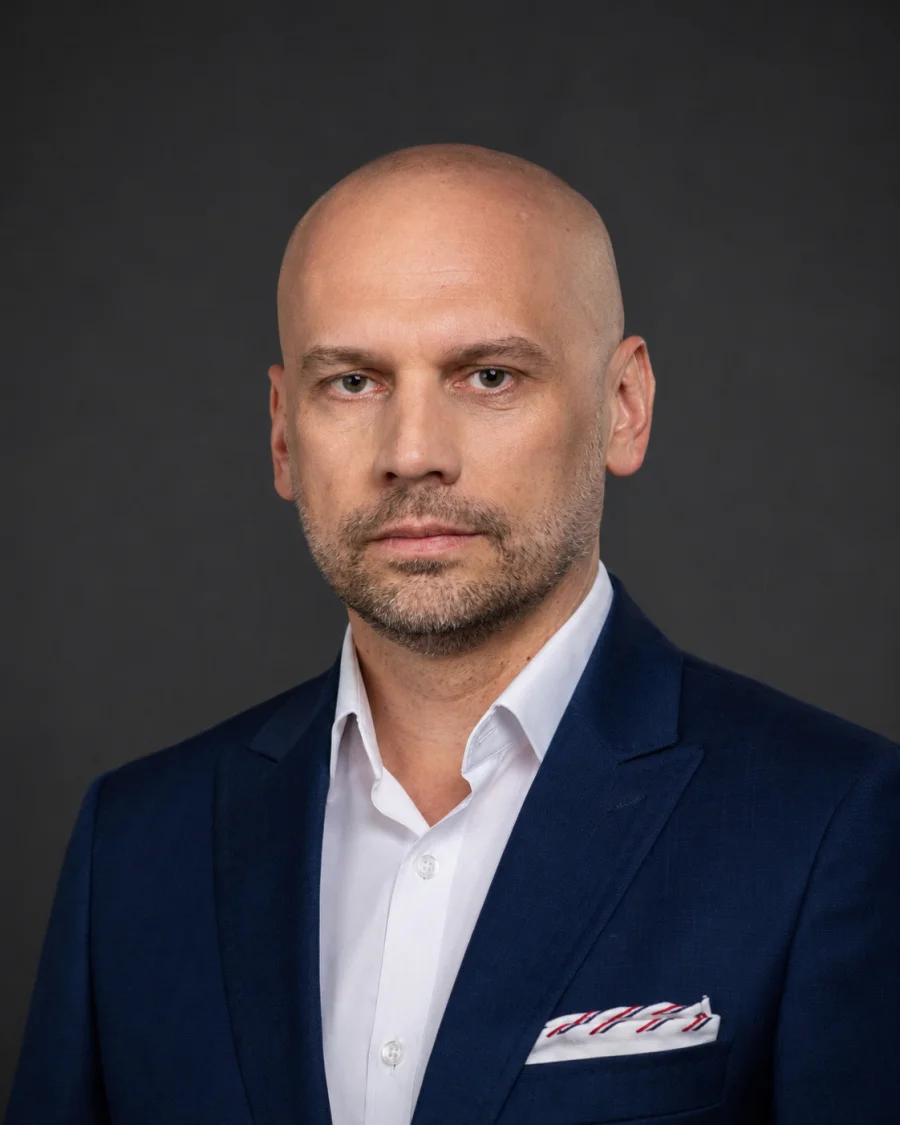
AUTHOR
Michał Zwyrtek
Partner
Combines a financial, advisory and digital perspective in strategic and implementation projects.
Full profile
Digital transformation, AI and new systems do not deliver results without change management. How to prepare the organisation, leaders and teams for real implementation.
Companies are investing more and more in ERP systems, automation, AI and digital tools. The problem is that technology alone rarely changes an organisation. Change has to be designed, communicated, carried out and reinforced – otherwise even the best system will remain an expensive add-on to old habits.
From our advisory practice we see this very clearly: the biggest risk in transformation today is not technology, but the organisation's lack of preparation. An unclear goal, no owner of the change, too many initiatives at once, employee resistance, insufficient leadership competencies and a failure to embed new behaviours in day-to-day work – these are what stall projects that looked excellent on paper.
A decade ago, change was treated as a project with a clearly defined beginning and end: implementing a system, restructuring, a new procedure, a merger. Today organisations operate in a state of continuous change. Technological pressure, digital transformation, artificial intelligence, new regulations, changes in the labour market, global economic tensions and constant cost and efficiency pressure all overlap.
In practice this means the board no longer has the comfort of "implementing one initiative and returning to normal". The new normal is running several, often a dozen or more, initiatives in parallel, changing processes, tools and the way people work. Change management has stopped being an add-on to an IT project – it has become a strategic board-level competency.
The recurring scenario of a failed transformation usually looks similar. Technology was bought, but the process was not changed. A system was implemented, but users were not prepared. Communication was limited to a single email from the board. Training only took place at the end of the project, when people were already tired and discouraged. No one calculated the impact of the change on teams' daily work. Too many initiatives were launched at once, and middle managers did not understand their role in the whole process. The project was run by an IT vendor, without a clear business owner on the company's side.
If an organisation does not know exactly what needs to change in people's behaviour, it is not managing change – it is merely installing a new tool.
The result is predictable: the new system works, but the old processes live on alongside it. People bypass the tool, export data to Excel, keep duplicate records, and after a year the board concludes that "the system didn't work". In reality, it was change management that did not work.
You do not need to build an academic theory of change to carry it out effectively. Classic models are best treated as a checklist that helps the board not to overlook the human side of transformation.
First, the sense of the old way of working has to be challenged – showing why the current model is no longer sufficient. Then people need to be led through a period of uncertainty, in which the old no longer works and the new has not yet become second nature. Finally, the new standards, processes and behaviours must be embedded in the rhythm of management, KPIs and daily work.
Without a sense of urgency, people will not change their priorities. Without a coalition of leaders, change will remain on the board's slides. Quick wins are needed to show teams that the new direction makes sense and that the effort is not wasted.
An organisation only changes when the behaviour of specific people changes. An employee must understand why the change is needed, want to support it, know how to work in the new way, be able to do it, and be confident that the new behaviour will be reinforced by managers and the incentive system.
Models are not an end in themselves. They are a tool for structuring the board's thinking about what must not be overlooked.
One of the most common mistakes we observe is starting transformation with the question "which system should we buy?". That question comes several steps too early.
Better questions for the board to start with:
An ERP, CRM, workflow, BI, AI or automation system only makes sense when it is embedded in a process and a management model. Without that, it remains an expensive licence gathering dust on a shelf.
Deploying artificial intelligence is not an ordinary IT project. AI changes the way work is carried out, the division of responsibility between human and tool, expectations regarding competencies, the management model, quality control, communication, and legal, ethical and organisational risks.
With AI, technology is often the easiest part. The hardest part is building trust, rules of use, competencies and new working habits.
In practice we see that four different attitudes to AI operate simultaneously within a single organisation. Some employees fear being replaced and avoid the topic. Some ignore the tools and believe their role will not change. Some use AI on their own – often without their manager's knowledge and without safety rules. And some managers do not know how to measure the output of a team in which AI is already genuinely performing part of the work.
That is why deploying AI requires not only choosing tools, but also a governance model, training, safety rules, a process map and a clear definition of where the decision still belongs to a human. Without this, AI becomes another source of chaos – this time fast-moving and hard to control.
Change fatigue is a phenomenon that rarely makes it onto a board presentation, yet often determines the fate of projects. Employees feel that "we're implementing something again". Too many projects run at once, new priorities keep appearing, old initiatives are never formally closed, messages are sometimes contradictory, and results are hard to point to.
The board should regularly review its portfolio of changes and answer simple questions:
Deliberately closing several projects can have a greater impact on the success of transformation than launching yet another one.
In the SME sector, transformation is most often led by the owner personally or by a narrow management team. There is a lack of time, competencies and budget. Decisions are practical and short-term, and implementations must show value quickly. At this scale, an MVP logic works well – automating one key process, simple no-code or low-code tools, deploying AI in a single area where the effect is immediately visible.
In large organisations the problem is different. Budgets are larger, but so is complexity, there are silos, more stakeholders and a greater risk of projects with no clear owner. The importance of PMO, governance, internal communication and a consistent rhythm of managing the portfolio of initiatives grows.
Put simply: in SMEs, change most often loses out to a lack of resources; in large organisations, to an excess of projects, internal politics and the absence of a single owner accountable for results.
Our practice at Zwyrtek Group shows that effective change management can be arranged into seven repeatable steps. This is not a ready-made recipe, but a framework that helps boards and owners avoid typical pitfalls.
Establish what genuinely needs to change: processes, roles, systems, data, competencies, the way decisions are made. Without an honest diagnosis, every subsequent decision is a gamble.
Change must have a goal expressed in the board's language: time, cost, quality, risk, margin, cash flow, compliance, scalability or customer experience. If a goal cannot be measured, it is also impossible to assess whether the change succeeded.
Who gains, who loses, who will block it, who needs to be engaged, who makes the key decisions. Most conflicts around transformation are predictable – if someone takes the time to anticipate them.
We do not start with technology. First we design the way of working after the change – the flow, decisions, roles, control points – and only then choose the tools to match.
Change requires language employees understand: why we are doing this, what will change, what stays the same, what is expected, when and how progress is measured. Middle managers must be the first, not the last, recipients of this communication.
Training must cover not just how to operate the tool, but above all the new process, accountability and decision-making. Post-launch support – hypercare, mentors, a fast-question channel – often determines adoption.
Change is only complete once the new way of working is visible in KPIs, reports, the rhythm of management and everyday behaviours. Only then can it be said that the organisation has genuinely gone through the change.
Zwyrtek Group supports organisations through change not only in an advisory capacity, but also operationally. We work with boards, owners and teams as advisers, interim managers or fractional managers, depending on the scale and pace of the transformation.
The scope of our support includes, among other things:
If you are planning to implement a system, automate processes, run an AI project or reorganise how your teams work – let's talk about change in your organisation.
Michał Zwyrtek combines advisory and management experience with the AgilePM®, PRINCE2®, MoR®, Change Management™, Design Thinking and PwC's BXT (Business, eXperience, and Technology) methodologies. This allows us to support organisations not only in designing change, but also in carrying it through processes, people, risks and management decisions – including in turnaround-management projects.
It is also worth looking at the scope of our services and the Zwyrtek Academy training catalogue, including programmes for leaders and teams going through change.
Combines a financial, advisory and digital perspective in strategic and implementation projects.
Full profileMichał Zwyrtek delivered a talk at the “Digital HoReCa: Automation and Security” conference on using AI, automation, revenue management and data in hospitality and food service.
Zwyrtek Group was a partner of the Marketing & Digital Experts Summit 2026 in Sopot. Michał Zwyrtek took part in a panel on data, AI, technology and organisational transformation.
Zwyrtek Group was a partner of Jantar Retail Forum 2026 in Szczyrk. Michał Zwyrtek moderated the closing panel discussion on the future of retail concepts, AI, automation and new customer-experience models.
We support boards and owners in designing and leading change: from diagnosis and decisions, through processes, people, risks and communication, to implementation and embedding new ways of working. We draw on advisory, managerial and methodological experience including AgilePM®, PRINCE2®, MoR®, Change Management™, Design Thinking and PwC's BXT.